
Intranets are more than just communication hubs—they serve as powerful content and service platforms that enhance employee efficiency and effectiveness. However, when intranets are poorly designed, lacking essential features or burdened by a cluttered UI, they can hinder productivity and negatively impact a company's bottom line.
A well-implemented intranet solution can provide a competitive edge. In fact, Deloitte research indicates that companies with strong internal social and work networks are 7% more productive.
Open source intranet CMS platforms have emerged as a leading choice for building modern intranets, offering scalability, customization, and enterprise-grade capabilities. Solutions like WordPress, dotCMS, Drupal, and Strapi provide flexible frameworks that cater to different organizational needs, allowing businesses to create tailored, cost-effective intranet experiences. Many organizations also opt for self-hosted intranet software to meet security and compliance requirements without sacrificing control.
In this article, we explore the best open source intranet software available in 2026—the best intranet software 2026 contenders—to help you find the right solution to enhance productivity and streamline internal communication.
What to Look For In an Intranet Content Management Software
Originally designed to boost productivity in physical office spaces, intranets have evolved to meet the demands of a modern workplace that is no longer confined to a single location. Today, the workplace is more of a concept than a fixed space.
Despite this shift, organizations still need a centralized hub where employees can easily access company information and communicate effectively. Without a well-structured intranet, employees struggle to find what they need, leading to inefficiencies and disruptions. In the absence of a unified system, employees often turn to their own tools, creating data silos and compatibility issues that can hinder collaboration.
These are some of the features you need to look for in a modern intranet content management system in 2026:
Intuitive user experience: Intranets shouldn't look different from other applications and software, and they need to be easy to use.
Integration with third-party applications: Modern intranets need to integrate with both corporate and consumer applications of all kinds.
Availability as a mobile application: Modern intranets need to be available as native apps or PWAs to reach employees truly.
Support for cloud office solutions: Be it Microsoft 365 or Google G Suite, an intranet needs to work with the office suite your company uses.
Personalization-ready: Modern intranets need to be able to personalize messages for both departments and users at a granular level.
8 Best Open Source Intranet Software CMS Solutions for 2026
Intranets connect all of an organization's teams, systems, and networks, elevating your operations to a whole new level, you already know that. But why open source? Simple, because you need a platform with a flexible information architecture. A platform you can tweak as per your company's needs and unique workflows.
Yet, that's not it. Whether you choose a cloud deployment or a self-hosted option, the main benefits of an open source platform for intranets include:
Lower costs: Open source platforms tend to be more cost-effective than proprietary software.
Extensibility: An open source intranet can be built into and can be extended to maximize growth.
Integrability: The open source architecture enables developers to integrate with other platforms without the constraints of a proprietary solution.
Powerful search: A modern intranet needs powerful search capabilities like Elasticsearch to be able to sift through all the data enterprise businesses have.
Now, let's take a look at the best eight open source intranet solutions you must know in 2026:
dotCMS
Intranet Portal
Build employee portals with structured content, permissions, workflows, and visual page editing.
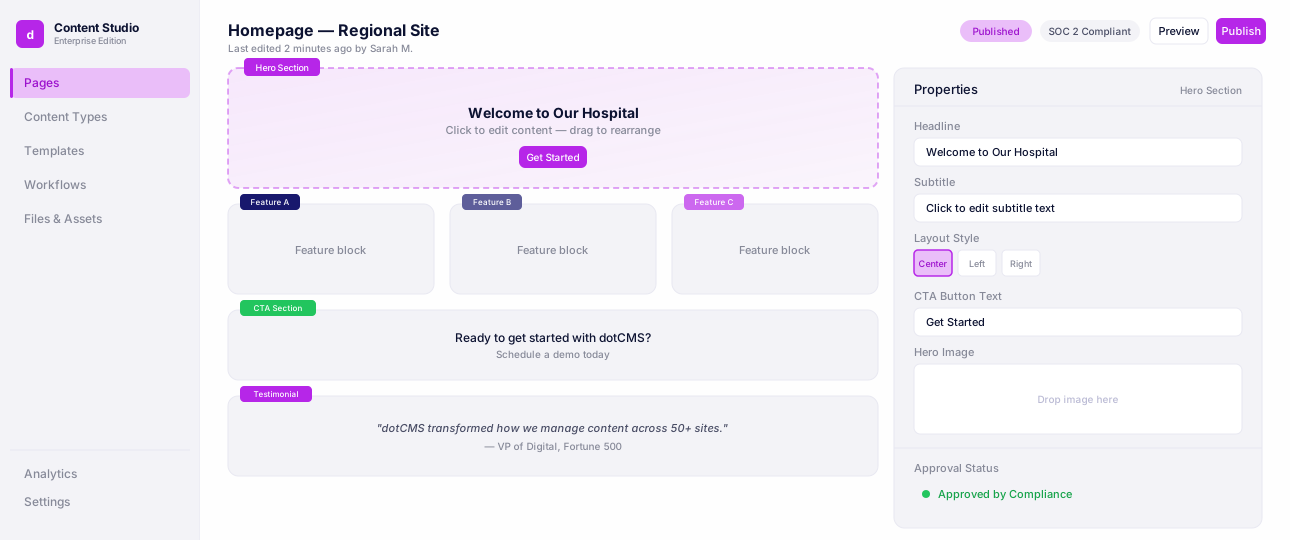
dotCMS is an open-source, Java-based content management system that enables businesses to build, manage, and deploy content-based applications such as websites, mobile apps, and intranets. A dotCMS intranet can support complex permissions, personalization, and robust content workflows.
Liferay

Liferay is a Java-based, enterprise-oriented DXP. Liferay enables users to set up intranets that behave just like websites built on top of a web application framework. Liferay DXP supports extensibility and works with every programming language capable of running the Java Runtime Environment.
Uintra

Uintra is a Umbraco-based intranet platform that takes from social media and combines news, events, and other company-wide activities into one collective feed for users. Like dotCMS, Uintra also leverages the capabilities of Elasticsearch.
eXo

eXo enables teams to connect, align, and engage around a single interface. With eXo, users can improve their peer-to-peer communication and improve collaboration. The intranet platform serves as a social networking platform that includes wikis and task management options. eXo also enables personalization, the creation of new spaces, and third-party integrations.
HumHub

HumHub is a free intranet platform and framework created to give users the tools to simplify collaboration and communication between workers. HumHub is a self-hosted platform that works with shared environments and supports themes and modules so users can extend their installation as much as they want.
Bitrix24

Bitrix24 is a social knowledge platform management and collaboration tool that is available for both self-hosted users or as a cloud service. Bitrix24 integrates communication and collaboration tools as well as activity stream, workgroups, and instant messaging. Bitrix is available for free to unlimited users.
TWiki

TWiki is a PERL-based content platform that gives users a wiki-like platform that stores workplace documents. TWiki also enables users to share files seamlessly with one another both as metadata within the files or in the database. TWiki integrates with G-suite for a seamless collaboration in the office.
Plone

Plone is a collaborative intranet solution. Quaive gives users a consistent user experience across multiple platforms and supports extensive collaboration and social tools. Quaive aims at providing users with an application-based experience with a dashboard that integrates a file viewer and rich content management tools.
Integrating The Intranet Into Your Digital Workplace
Information isn't static. It changes and mutates with every person, and while this is good for everyday life, it might not be so for the workplace. A modern intranet, especially an open-source one, gives you the tools and the flexibility to connect departments and systems to make sure you always have a single source of truth in your company and that you can always know where the information originates from.
An intranet works as a designated communication and collaboration room for your company, something that brick-and-mortar offices simply don't have. By adding an intranet to your digital workplace, you're giving your employees a place where they can communicate productively and in one place, reducing the need for disparate software across the organization.
With a hybrid CMS like dotCMS, you gain a tool with which you can centralize your company-wide communications and enhance your workers' productivity. Plus, companies can strengthen their business to employee experience and update content, marketing collateral, promotional materials for employees, and search for documents faster with an intranet. Check out the TELUS success story to see how they improved B2E experiences with dotCMS.
With a modern intranet built on a hybrid CMS like dotCMS, IT teams don't need to worry about updates and maintenance, since we are a cloud-based platform. Also, being a cloud platform reduces the platform's latency, reducing the time it takes for content editors to add information to the platform.
Want to see how dotCMS can streamline your company's communications and boost productivity? Schedule a meeting with our team to discuss your intranet needs and how we can help.
FAQ
Q&A
Short answer: Focus on usability, integrations, mobility, office-suite compatibility, and personalization. Specifically:
Intuitive user experience that feels like any modern app
Broad integrations with third‑party corporate and consumer tools
Mobile availability (native apps or PWAs)
Support for cloud office suites (Microsoft 365 or Google G Suite)
Granular personalization for departments and individual users
Short answer: Open source gives you a flexible, scalable foundation you can tailor to your workflows while keeping costs in check. Key advantages include:
Lower costs versus proprietary software
Extensibility to grow and adapt over time
Easier integration with other platforms (no vendor lock‑in constraints)
Access to powerful search (e.g., Elasticsearch) to cut through enterprise data
Option to self‑host to meet security and compliance needs without sacrificing control
Short answer: The article spotlights eight options, each with distinct strengths:
dotCMS: Open‑source, Java CMS with complex permissions, personalization, and robust workflows for content‑driven intranets.
Liferay: Java‑based DXP for enterprise intranets with strong extensibility on the Java Runtime Environment.
Uintra: Umbraco‑based, social‑style feed for news, events, and activities; leverages Elasticsearch.
eXo: Social intranet with wikis, task management, spaces, personalization, and third‑party integrations.
HumHub: Free, self‑hosted framework with themes and modules for extensible collaboration.
Bitrix24: Collaboration suite (self‑hosted or cloud) with activity streams, workgroups, and IM; free for unlimited users.
TWiki: Perl‑based wiki platform for document storage and sharing; integrates with G Suite.
Plone: Collaborative intranet with a consistent UX, social tools, dashboards, and rich content management.
Short answer: It centralizes information and communication, reducing silos and tool sprawl so employees find what they need faster. The article notes:
A unified hub prevents fragmented tools, data silos, and compatibility issues.
Teams gain a designated space for communication and collaboration.
Better access to accurate, single‑source‑of‑truth information streamlines work.
Strong internal networks correlate with higher productivity—Deloitte cites a 7% uplift.
Short answer: dotCMS combines enterprise‑grade content management with cloud convenience. Highlights include:
Open‑source, Java‑based CMS supporting complex permissions, personalization, and robust content workflows
Hybrid CMS approach to centralize company‑wide communications and improve B2E experiences (e.g., the TELUS success story)
Cloud‑based delivery so IT doesn’t worry about updates and maintenance, with reduced latency for faster editing and publishing
Flexibility to integrate with your broader digital workplace and streamline content, documents, and internal campaigns